Category Archives: Symposium

Symposium on Academic Freedom

The right to enquire? A Symposium on academic freedom

Tuesday 25 November 2025
The University of Melbourne, Parkville

Presented by the Australian Academy of the Humanities and the Council for the Humanities, Arts and Social Sciences (CHASS)

What does it mean to define, contest, and safeguard academic freedom in the 21st century?

Academic freedom is a cornerstone of democratic societies and the lifeblood of scholarly endeavour. Yet, across the world, we are witnessing growing pressures — political, cultural, and economic — that threaten to constrain open inquiry. Australia is not immune. Join leading scholars, journalists, and advocates to explore how academic freedom can be understood, protected, and renewed in our time. This is a free public event.

Fulcrum: Science and Tech before 1500

On the 24th October ANU’s Dr Tatiana Bur will launch Fulcrum, Australasia’s network for the study of science and technology before 1500. Please find the program below.

Fulcrum is a group of Australasian scholars working on a broad range of premodern scientific and technological themes, with a particular emphasis on their interactions with other elements of culture such as gender, religion, philosophy, art, identity, history and historiography. You can find further information at:

www.fulcrumnetwork.me

You are invited to the official launch of this new body on 24 October, which will feature conversations between scholars from Classics, Assyriology, science communication, the history of medicine, cultural arts, philosophy and cybernetics on a range of themes relating to modern science and technology.  

The event is free, and is an all-day event held on campus from 9 am to 5 pm. The programme is attached, with venues to be advised closer to the date.

If you would like to register to attend, you can do so via the following link:

https://events.humanitix.com/fulcrum-launch

Please touch base with Tatiana Bur for any inquiries (Tatiana.bur@anu.edu.au).

Symposium: Marginalia and the Early Modern Woman Writer, 1500-1700

When: 8 August, 2025
Where: National Library of Australia

Early modern women marked their books in myriad ways, and their marginalia provide evidence of their book ownership, their reading, writing and drawing practices, their acquisition of literacy, and the interrelation of body, book, and material world. This one-day symposium interprets this exciting new textual corpus and discusses the challenges involved in locating, attributing and analysing this material. What can marginalia tell us about women’s textual agency, education and literacy, their use of books, their lived experience of household economics, organization and technologies, and their interpersonal, affective and social relationships? What evidence does marginalia provide for women’s engagement with orality, performance, print, and scribal cultures? How can marginalia help us position women as humanist, political and religious agents and understand their worlds of work and leisure? And how can such new analyses of early modern women’s marginalia reshape early modern marginalia studies more broadly?

The symposium will include keynotes by Professor Micheline White (Carleton University), Emeritus Professor Paul Salzman (La Trobe University), Professor Sarah C.E. Ross (Victoria University of Wellington) and Dr Emma Rayner (Australian National University).

For details and registration, click here.

CFP Reminder: Marginalia and the Early Modern Woman Writer, 1500-1700

Call for Papers: Marginalia and the Early Modern Woman Writer, 1500-1700

Call for Papers: Marginalia and the Early Modern Woman Writer, 1500-1700
National Library of Australia, August 7-8 2025
***PROPOSALS DUE MONDAY 14 APRIL 2025***

Early modern women marked their books in myriad ways, and their marginalia provide evidence of their book ownership, their reading, writing and drawing practices, their acquisition of literacy, and the interrelation of body, book, and material world. This symposium invites papers and panels interpreting this exciting new textual corpus and discussing the theoretical and methodological challenges involved in locating, attributing and analysing marginalia by early modern women, elite and non-elite, known and unknown. What can marginalia tell us about women’s textual agency, education and literacy, their use of books, their lived experience of household economics, organization and technologies, and their interpersonal, affective and social relationships? What evidence does marginalia provide for women’s engagement with orality, performance, print, and scribal cultures? How can marginalia help us position women as humanist, political and religious agents and understand their worlds of work and leisure? And how can such new analyses of early modern women’s marginalia reshape early modern marginalia studies more broadly?

20 minute papers and panels are invited on any aspect of early modern women’s marginalia, but might consider the following topics:

  • Marginalia, book ownership, book collecting, and provenance
  • Marginalia as evidence of early modern women’s reading
  • Marginalia as evidence of early modern women’s writing
  • Visual and material cultures in early modern women’s marginalia
  • Authorship, attribution and agency
  • Form and genre
  • Marginalia and sociability
  • Marginalia, politics and power
  • Marginalia and race
  • Non-elite women’s marginalia
  • Marginalia, education and literacy
  • Marginalia, emotion and affect
  • Marginalia and haptics
  • Marginalia and heuristics

Invited speakers include Professor Micheline White (Carleton University), Professor Katherine Acheson (University of Waterloo), Professor Paul Salzman (La Trobe University), Professor Sarah Ross (Victoria University of Wellington), and Dr Hannah August (Massey University)

The symposium will also launch the database Early Modern Women’s Marginalia: The Library of Libraries, with over 3000 examples of early modern women’s marginalia from 100 archives worldwide, hosted by the Centre for Early Modern Studies at the Australian National University. Please send a 200 word abstract (or panel proposal) plus a short biography to admin.cems@anu.edu.au by 14 April 2025.

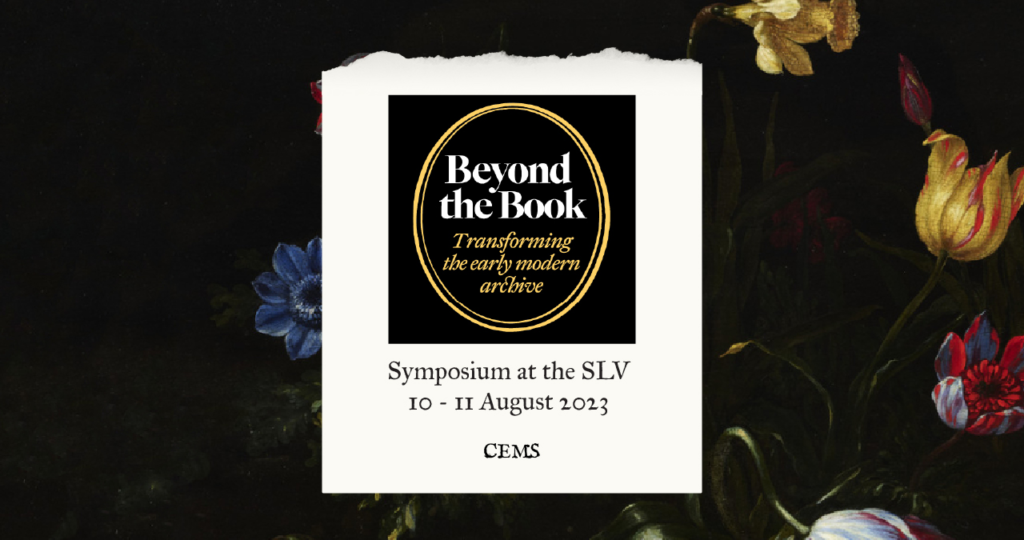
Symposium: Beyond the Book, Transforming the Early Modern Archive

ANZAMEMS members and friends are invited to Beyond the Book: Transforming the Early Modern Archive, a free two-day symposium to be hosted by State Library Victoria, on 10-11 August, 2023. 

Join digital designers, specialist librarians and early modern scholars to explore how traditional archival scholarship and emerging digital technologies can combine to bring materials from the past to new audiences.

This event will celebrate the culmination of the ARC Linkage Grant project Transforming the Early Modern Archive: The John Emmerson Collection at State Library Victoria and will launch its digital exhibition, Beyond the Book: A digital journey through the treasures of the Emmerson Collection.

Register here to attend in person, watch via livestream, or access recordings afterwards.

ANU’s Centre for Early Modern Studies is offering 10 bursaries of $500 AUD to enable HDR students to attend in person.  Applications can be made here

Link to the collection of events: Beyond the Book: Transforming the Archive | Eventbrite

10th August events

11th August events

IMS Conference: Play in the Middle Ages

Play in the Middle Ages Les Jeux au Moyen âge
International Medieval Society (IMS Paris) 17th annual conference
Société Internationale des médiévistes de Paris 17 e colloque annuel

A virtual symposium | Un symposium virtuel
May 22 , 2023 16:00 18:30 CET (Paris time)
22 mai 2023 de 16 h à 19 h 30 CET

To register, please visit this website.
For any further information or questions please email dafnani@post.bgu.ac.il

Registration now open: Medieval Matters: A symposium on the future of medieval studies in honour of Prof. Miri Rubi

Medieval Matters

A symposium on the future of medieval studies in honour of Prof. Miri Rubin

June 29–30 (in person)

Arts Two Lecture Theatre

Queen Mary University of London

335 Mile End Rd, London

For a full programme and to register: https://www.eventbrite.co.uk/e/medieval-matters-a-symposium-in-honour-of-professor-miri-rubin-tickets-591565848377

Monash CMRS symposium

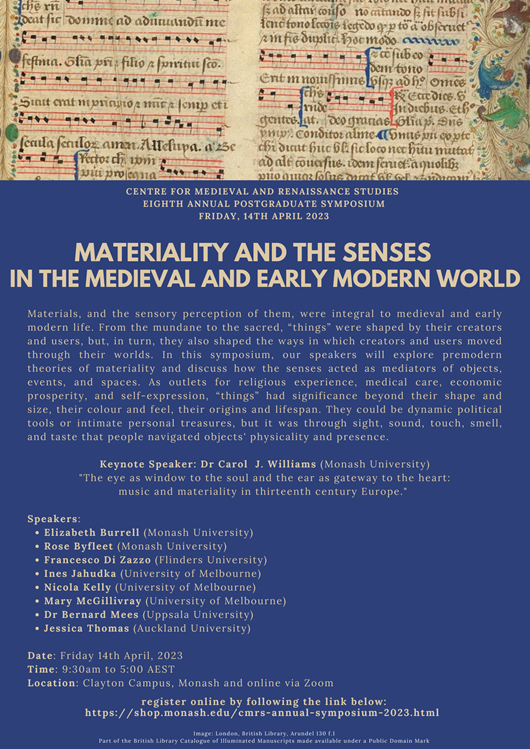
“Materiality and the Senses in the Medieval and Premodern World,” Eighth Annual CMRS Postgraduate (Hybrid) Symposium, 14 April.

We are pleased to announce that registration for the Eighth Annual CMRS Postgraduate Symposium that will take place on 14 April is now open. Our theme this year is “Materiality and the Senses in the Medieval and Premodern World”.

Materials, and the sensory perception of them, were integral to medieval and early modern life. From the mundane to the sacred, “things” were shaped by their creators and users, but, in turn, they also shaped the ways in which creators and users moved through their worlds. In this symposium, our speakers will explore premodern theories of materiality and discuss how the senses acted as mediators of objects, events, and spaces. As outlets for religious experience, medical care, economic prosperity, and self-expression, “things” had significance beyond their shape and size, their colour and feel, their origins and lifespan. They could be dynamic political tools or intimate personal treasures, but it was through sight, sound, touch, smell, and taste that people navigated objects’ physicality and presence.

Our keynote speaker for the event will be Dr Carol J. Williams and we also have a fantastic range of speakers presenting throughout the day. This is a hybrid event and will be occurring on our Clayton Campus as well as on zoom. Free registration can be found here and closes on the 4 April. Virtual registration can still occur after that by emailing the CMRS at cmrs-postgraduatecommittee@monash.edu.


Hakluyt Society Essay Prize 2023

The Hakluyt Society awards an annual essay prize (or more than one, if the judges so decide) of up to a total of £1,000. The competition is open to any registered graduate student at a higher education institution (a university or equivalent) or to anyone who has been awarded a graduate degree in the past three years. If possible, the prize will be presented at the Hakluyt Society’s Annual General Meeting in London in June 2023.

Prizewinners will be invited to present a paper on the topic of their essay at a Hakluyt Society Symposium (in which case travel expenses within the UK will be reimbursed) and will also receive a one-year membership of the Society. Submissions for the 2023 prize are now invited, the deadline for which will be 30 November 2022. For further details, and instructions on how to submit your essay, please download the information sheet (which includes a style guide) at https://www.hakluyt.com/hakluyt-society-essay-prize/

Please forward any enquries about the scheme to office@hakluyt.com.